Blog Archives

Fog Talking

The title for today’s post comes from the word athastokhdevishizar, which means “nonsense”, but which literally translates as “fog talking”. It was also used in the first Dothraki haiku submitted in response to last week’s post. As it happens, it was authored by ingsve, whose (at the time of writing) birthday it is! Happy birthday, ingsve! Here’s what he wrote:

Anha tokikof?
Athastokhdeveshizar!
Anha dirgakof!

Which translates to (translating loosely):

I’m a big idiot?
Nonsense!
I’m a deep thinker!

You can let me know how close I got to what you were thinking. Ordinarily yes/no questions are preceded by hash, but I think the lack of hash here works to make this kind of an echo question (e.g. “You’re nothing but a lazy daffodil!”, “I’m a lazy daffodil?!”).

Another of ingsve’s is his birthday-inspired haiku:

Kisha vazhaki
Chisen ma at halahis
Lekhmovekaan.

Which is:

We will give
Thirty-one flowers
To the conlanger.

San athchomari, zhey ingsve! I’d coined the word lekhmove for “conlang” previously, but this is the first time I’d seen lekhmovek for “conlanger”. I like it!

I made one correction above: What was halahi in the original should be halahis, as it’s a plural direct object (and halah is an animate noun). And, since it’s his birthday (and I believe we’re the same age), here’s a haiku back, zhey ingsve:

Ma anha vazhak
Chisen ma at halahis
Dirgakofaan.

It’s funny. A lot of times it’s hard to fit large Dothraki words into the slender frame of a haiku, but in both of these, we had to not contract a word in order to get the right number of syllables.

One more of ingsve’s: An ambitious attempt to translate Robert Oppenheimer’s quoting of the Bhagavad Gita. Here’s what he came up with:

Ajjin anha ray
athdrivaroon, drozhak
rhaesheseri.

For those unfamiliar, the quote is, “Now I am become Death, the destroyer of worlds”. If I were to translate the above, this is how I would translate it:

Now I was already
Death, killer
Of worlds.

In order to tackle this translation, one has to come to terms with the English, which, I think most native speakers would admit, is fanciful, at best. If one were to switch out “Death” for, say, “teacher”, one would probably say, “Now I’m a teacher”, or, perhaps, “Now I’ve become a teacher”. The use of “am” is reminiscent of an older form of English where people said things like, “Now I’m come” to mean “Now I’ve come” (if you want to learn more about it, look up unaccusative verb and prepare to have your mind melt). Dothraki doesn’t have anything like that (he said, sweeping under the rug material for potential future blog posts), though, so before one translates the quote, one has to reword it a bit.

It was Qvaak, I believe, who pointed out that I translated something similar for the LCC4 relay. In that text, I translated the line, “The crone turned into a wolf” as follows:

  • Yesi nemo ficho mehas venikh veri.
  • /crone REFL obtain therefor semblance-ACC wolf-GEN/
  • “The crone got unto her the semblance of a wolf.”

That could work, technically, but I get the sense that it would mean something more like, “I took on the semblance of Death”, or, “I turned into Death”, which I think kind of defeats the tone of the thing. It’s more direct as it is, and the translation should reflect that.

So if I had to translate it, I would probably just have it as (not trying to keep to the haiku form):

  • Ajjin anha Athdrivar: Ohharak rhaesheseri.

Perhaps one could say “Athdrivaraan” and cast it as the future tense. Depends on how you read it. Nice job, ingsve! Way to push the envelope.

Next, Qvaak did a series of seasonal haiku, which I’ll look at it inverse order. Let me know if I got these right. The first:

Hrazef vos govo.
Chaf ish atthasa okre,
Chiori memras.

The horses don’t mate.
The wind maybe fells the tents,
A woman therein.

I made a slight correction (typo: hrazhef for hrazef), but otherwise I think that’s about how it translates. Nice use of the adverbial preposition! Next:

Halah she sorfo;
Negwin nem eyyelie.
Dani vekh hazze.

A flower on the ground;
A stone is spotted.
A gem is there.

I have to admit this one sent me to my dictionary. I knew eyel was “rain”, but the verb eyyelilat is something that Qvaak coined for this poem. The verb eyelilat is a stative verb meaning “to be spotted” (like the ground after it’s begun to rain lightly). Qvaak causativized it to produce eyyelilat, which means “to spot” or “to put a spotted pattern on”—then he passivized it! Nice.

I was trying to figure out what the poem actually means, and what I can guess is that there’s a rock, and there’s actually a gem inside, which you can see sparkling? Reminds me this old thing. The meaning of the flower, though, escapes me.

Edit: If you take a look at Qvaak’s comment below, you’ll see that he meant “ford” when he used dani. “Ford”! I never thought I’d see another person use that word in a million years. The idea is to evoke spring rains and spring flooding.

Next!

Kash shekh vervena,
Kash hranna veltoroe;
Voji virzethi.

When the sun is violent
The grass yellows;
Red people.

Yet again, Qvaak coined a word, and it makes perfect sense. Veltor is the word for “yellow”, and veltorat means “to be yellow”, so, of course, veltorolat means “to yellow” or “to grow yellow”. Very nicely done! If only it would have fit the syllable count, I think vervenoe would’ve worked even better in place of vervena.

Now, as for “red people”, I have to ask: Did you mean “sunburned people”? If so, nice try! When I get around to it, there will probably be a different word for “sunburned”. (Virzethoe would also work well, though, again, it’d be one syllable too many.)

Edit: Qvaak intended “People are red” as the translation of voji virzethi, but either translation works.

Excellent haiku, you guys! But, of course, there can only be one “winner” (in the non-contest sense): Only one that can claim the mighty and fearsome Mawizzi Virzeth (the Red Rabbit). And here it is, the first from Qvaak’s seasonal series (and below that an audio file of me reading it):

Vorsa erina.
Ikh dozgosoon anni;
Ahesh sash qisi.


At first I didn’t even read it right, because I thought the verb in the first line was an adjective. But, indeed, it’s a verb. Here’s my translation:

Fire is kind.
Ashes from my enemies;
Fresh snow nearby.

Now that’s evocative! Nicely done! And for penning my favorite of the bunch, you win the “coveted” Mawizzi Virzeth:

The 2012 Red Rabbit Award presented to Qvaak.

This precious award comes with no physical prize. In fact, as the Dothraki don’t value money, it doesn’t even come with a virtual prize. It does, however, come with much respect. San athchomari, zhey Qvaak! And thanks to both Qvaak and ingsve for submitting haiku! I know specific grammatical information on Dothraki isn’t easy to come by even now, and the available lexicon is smaller than the total lexicon, but you took the plunge! And for that, I salute you.

In other news, if you haven’t seen it elsewhere, I’m going to be presenting on Dothraki at the Southwest Texas Popular Culture and American Culture Association Conference next month. The conference is being held from February 8th to the 11th, and my talks will be during the day on the 9th, and in the evening on the 10th. The latter is open to the public. So, if you happen to be in Albuquerque, New Mexico, stop on by! It’ll be lots of fun.

Update: Added audio of Qvaak’s poem.

Asshekhqoyi Anni

Today is my 31st birthday, which seems like a much more frightening prospect than my 30th… But at least I have two years until my 33rd. If you’re wondering about the featured image for this post, the explanation is quite simple: Since I’m writing this post before my actual birthday, I don’t have any pictures from my birthday, which led me to go back to photos from my previous birthday, when my wife took me to Vegas, where many hotels featured displays inspired by Chinese New Year (at the time, the Year of the Rabbit), and, as a big fan of rabbits (and topiary), I, naturally, had to take some pictures. And, yes: I do have more pictures. Many more.

I was trying to figure out something fun to do for my birthday, and then…I figured it out. (I couldn’t think of a snappy way to finish that sentence. Then I started writing the last one. And now this…) Back on December 17th, I did an interview with Monique Stander for a South African radio station. The interview was at midnight, and I got a call from a station assistant a half hour beforehand to make sure I was there and ready. Once that had been ascertained, he also asked if I’d write a haiku, since they were talking about haikus on the show that day. I asked him if he wanted one in English or Dothraki, and he said English, so we hung up and I started writing a haiku in English (kind of tough to come up with a good one, but I did my best).

He then called back at 11:55 p.m. and said that, in fact, it was in Dothraki they wanted the haiku, not English. He asked how much time I had, and he said three minutes. So we hung up again, and in three minutes, I came up with this:

Sajo anni ma
Haja ma ivezhofa.
Sek. Me nem nesa.


Which is (approximately): “My horse is / Strong and fierce. / Yes. It is known.” It’s not Bashō, but at least it has the right number of syllables in the right places (something I wasn’t sure of when I went on the air!).

Since we’ve got all the time in the world here on the internet, I thought a Dothraki haiku might be a fun (and relatively manageable) translation challenge! So the gauntlet is cast. If you’re interested, write a haiku in Dothraki. For the purposes of this contest, a haiku is 17 syllables long, with the syllable counts for each line being 5, 7 and 5, in that order. If you need to fudge, we’ll set up a separate category for haiku that are 17 syllables, but maybe don’t hit the right line numbers.

Also (and this is important), since this is Dothraki, we are definitely going by syllable count, not mora count. Regarding syllable-counting, in Dothraki, a syllable is defined as a vowel plus one or more consonants on either side. A syllable cannot contain more than one vowel, which means that a word like kishaan is trisyllabic, not disyllabic.

If it helps, you may or may not contract the various prepositions that contract. So, for example, mr’anha (two syllables) is the usual way of saying “inside me”. For your haiku, if you wish, you can separate the two out, i.e. mra anha (three syllables). You can also drop purely epenthetic e vowels (so the past tense of “crush”, kaffe, can be rendered as kaff’). Feel free to play with word order and drop pronouns, as needed, bearing in mind that such language is figurative, and the reader will still need to be able to figure out who’s doing what to whom.

So, there it is! Good luck! Feel free to post responses in the comments to this post, or e-mail them to “dave” at “dothraki” dot “com” (feel free to include audio!). I’ll discuss the responses in a future post, and will possibly give my favorite some sort of (likely virtual; definitely rabbit-related) prize. If you need any help, head over to Dothraki.org, and you should find what you need.

Fonas chek!

2011 Conlang Card Exchange

For the past three years, a number of conlangers have participated in the Conlang/Concultural Card Exchange. I participated the first year with Kamakawi, but missed the deadline the next year, so I wanted to be sure to participate this year (though I still almost missed the deadline). For this year’s exchange, I decided to use Dothraki, and I thought this would be as good a place as any to post the translation info for my card.

First, here’s what the front of the postcard looks like:

A picture of a donkey.

Click to enlarge.

And here’s a shot of the back of the postcard:

The back of my Conlang/Cultural Card Exchange card (2011).

Click to enlarge.

(Note: That’s the LCS’s address, not mine. Don’t send mail there unless it’s accompanied by a $35 membership check made out to “LCS” [by the way, with the holidays around the corner, why not give the gift of LCS membership! Okay, plug over].)

Now, when I made these up with Costco, they gave me a character count, and I swear I came under that character count! But, as you can see, the text got cut off—literally. In fact, there was one more line after what you see there (I’d signed it Devvo ki Drogosi. Oh well). So you don’t have to go squinting, here is the entire text (plus the missing line):

Aheshke ray jad, majin anha vazhak yeraan azh, hajinaan m’anha chomak yeraan sekke. Jin vezh hrazef avervenanaz drogikhoon anni. Yer laz tihi mae mra jerve she hatif. Me drozhak! Tihas vorsaes tihoa ma charas tem fogoon! Ma me lana ven chaf! K’athjilari: Vo cheyi ven mae vekho vosecchi. Ma me yeri! Vezhof gora ha yeraan. Me nem nesa.

Fonas chek!

Devvo ki Drogosi

Now, I don’t want the card recipients to jump through too many hoops, so here’s an interlinear (though this won’t be pretty. Does CSS do small caps yet…?):

/winter already come.PST and 1SG.NOM FUT-give-1SG 2SG.ALL gift.ACC because COMP-1SG.NOM respect-1SG 2SG.ALL very. this stallion horse SUP-wild-SUP herd-ABL 1SG.GEN. 2SG.NOM can see-2SG 3SG.ACC in cage at front. 3SG.NOM killer! see-IMP fire-ACC eye-ABL.PL and hear-IMP thunder.ACC hoof-ABL! and 3SG.NOM run-3SG like wind! truly: NEG bay-GEN like 3SG.GEN exist-3SG.NEG NEG.EMPH. and 3SG.NOM 2SG.GEN! horse.god charge-3SG for 2SG.ALL. 3SG.NOM PASS know-3SG./

/hunt-IMP well!/

/Dave by Drogo-GEN/

Or better yet: Have they made a WordPress plugin for interlinears yet? Any conlangers out there who are big into WordPress and coding? (Think that’s what we need to get this done…)

Anyway, there you have it! Translation shouldn’t be tough (remember that the ablative expresses inalienable possession and that it’s only optionally expressed). Feel free to post your translation in the comments, and I’ll tell you how you did.

Also, I ordered 10 cards, since I thought that’d be a good round number, but I have three leftover. I thought I’d have a contest and give away the remaining three, but that would involve you giving me your address, so I thought I’d better make it voluntary. So! If you would like a card, and if you’re comfortable giving me a mailing address you have access to, e-mail me at “dave” at-sign “dothraki.com” and let me know. I’ll send them out to the first three people that e-mail me with addresses, and I’ll personalize them somehow in what little space there is left on the card.

Fonas chek, zhey lajaki!

Update: All the cards have been claimed. Perhaps there will be more next year, or for some other holiday (do the Dothraki celebrate Flag Day…?). Who knows? These, though, are being sent out to stud. But let me tell you: If there is a next time, ain’t nothing getting cut off—I’ll make sure of that!

The Header Script

I’ve gotten a few questions about the script in the header (the one in black below the word “Dothraki” in white), so I thought I’d address it, even though it doesn’t relate much to Dothraki itself.

First (in case there’s anyone who can’t make it out), it’s intended to say “Dothraki” in English (works if you kind of squint your eyes at it [especially when you get to the "a"]). Even so, the script was not intended to be a Roman font: it was created for a conlang.

Back in mid-2010, when I was working on season 1 of Game of Thrones, I was also participating in a group conlang creation project (the language was called Kenakoliku). It didn’t end up being successful (group projects are very difficult to maintain), but it was fun at the time. Since my favorite part of creating a language is creating its orthography, I devoted my energies to creating a possible orthography for Kenakoliku.

I initially fonted up five proposals (just one character for each): two instantiations of someone else’s hand-drawn proposal, and three of my own. They’re shown below:

Five orthographic proposals for Kenakoliku.

Click to enlarge.

I actually liked the one called “Curvy Glyphs” the best, with “Kadani B” coming in a close second (for some reason it reminded me of those block Greek letters you see on fraternity houses…), but most everyone else liked what I called “Halfsies”: an orthography where the consonant was on the bottom, and the vowel on the top. As a result, I filled the font out, creating possible consonant and vowel characters without assigning any values to them (so people on the board could choose which ones they liked best). Here’s the chart I came up with:

Full version of the Halfsies font.

Click to enlarge.

From this sample, everyone (mostly) settled on form-sound combinations they liked, and I produced a font, a sample of which is shown below:

A sample of the full Halfsies font.

Click to enlarge.

The font had some problems, and I mostly fixed them so that the font worked in my word processor of choice, but then it still had problems in other word processors, and then the language itself kind of wound down anyway, so I abandoned the project and the script. If you’d like, you can download what remains of the font and toy around with it here (.zip). I warn you, though: the ligatures may not work on your end, and I’m no longer maintaining it.

Anyway, several months later, Game of Thrones debuted, and I started up a LiveJournal account mainly to make comments on George R. R. Martin’s LiveJournal. In order to do so, though, I needed an icon. I didn’t want to use a picture of one of the actors from the show (or, even worse, a picture of me), and Dothraki didn’t have its own script, so I was in a quandary. I’d always liked the Halfsies font, though (I always referred to it in my head as the Swashbuckler’s Script), and one of the characters kind of looked like a “D”, so I made it my LJ icon:

The Dothraki D.

And that’s been my little Dothraki icon ever since.

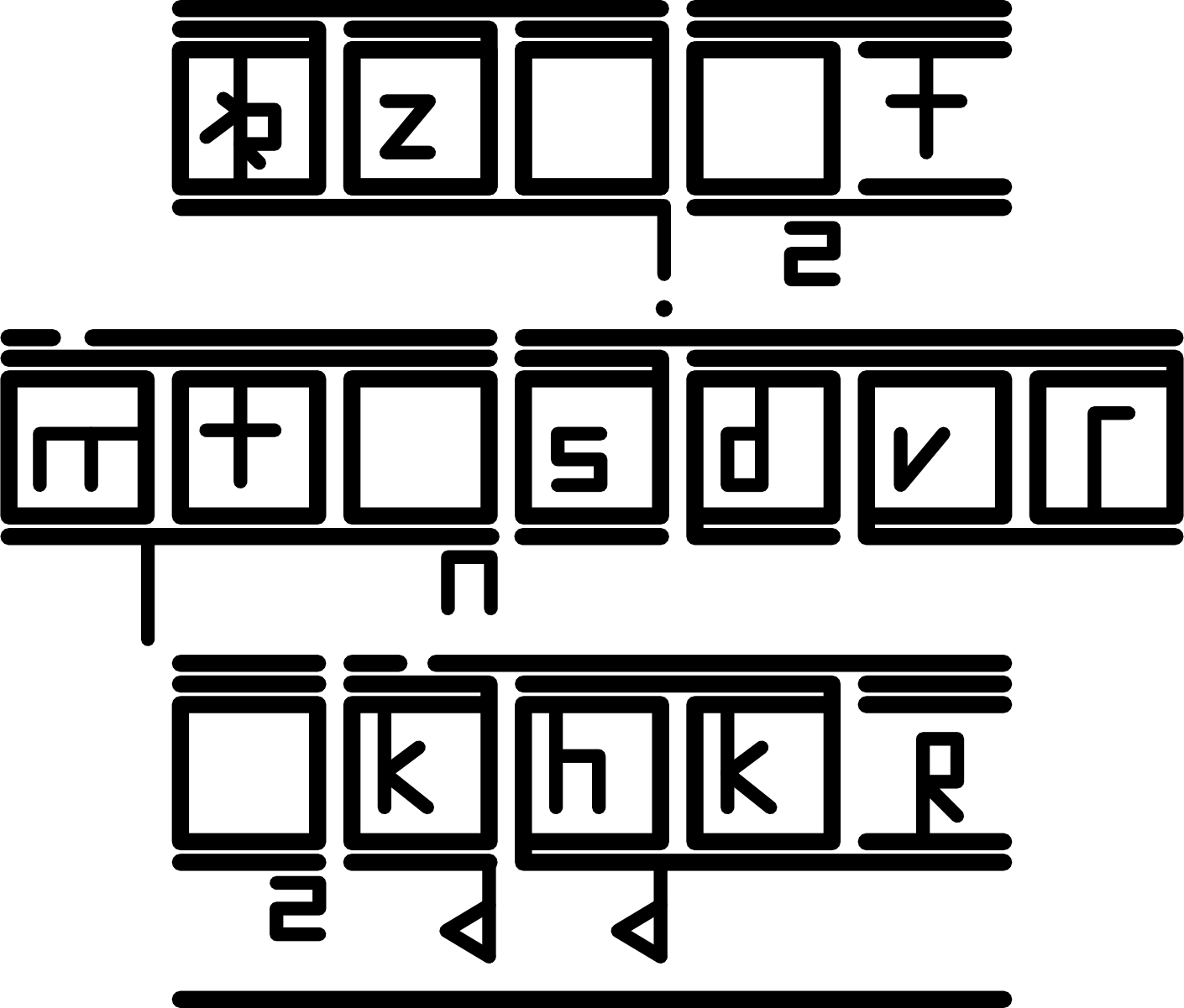
When it came to making this blog, I found a theme I really liked (props to digitalnature!), but the font in the header looked way too plain (sans-serif?! Decidedly un-Dothraki!). And since I didn’t want to actually go in and mess with the CSS, I just created a background image with the Halfsies font. In order to get something that looked like English, I had to pick and choose characters (and alter some, using Photoshop), some of which you will have seen in the image above:

Characters used in the background image.

Click to enlarge.

And eventually I had it.

So that’s the story behind the script in the header. The look of it was, indeed, inspired by Devanāgarī, but the actual structure is a bit different. The font above can’t actually be used to write English (it’d need a lot of work for that), but maybe if someone’s interested they can take it and manipulate it.

I feel like I should have something related to Dothraki in here, since this is a Dothraki blog. Let’s see… If I had to give “Halfsies” a name in Dothraki it’d probably be Lirisirazo (a class B inanimate noun, as all noun-adjective compounds are that end in a vowel), which means something like “Bladed Writing”.

Also, for the curious, Dothraki is now up to 3,163 words: More words than Mr. Padre Tony Gwynn has hits, but still a ways to go to catch Pete Rose (and my guess is Dothraki will have double his number before he gets even a sniff of the Hall of Fame).

Dothraki Writing System…?

Periodically I’ll spotlight cool stuff being done by Dothraki community members here on the blog. Today I want to take a look at something really cool done by Dothraki.org member Qvaak.

Prior to the Fourth Language Creation Conference, attendees took part in the LCC4 Conlang Relay. To start the relay off, I provided a text in Dothraki about an incorrigible goat.

That was pretty much the end of the story, until recently, when I got a tweet about the existence of a possible orthography for Dothraki. The tweet linked to the following image:

LCC4 Relay Text in Dothraki Calligraphy.

Click to enlarge.

Check that out! That’s the text of my leg of the relay written in a modified romanization designed for Dothraki by Qvaak. Pretty cool! Here’s a summary of the changes that were made with commentary:

  • y > j: Probably doesn’t make a lot of sense to English speakers, but this is common enough in European languages (e.g. German, Dutch, Finnish, etc.).
  • ch > c: It seems that one of Qvaak‘s goals here was to remove all the digraphs, which is a good idea, generally, but something I didn’t want to do for (primarily) English-speaking actors. For example, if chomat was spelled comat, no English speaker would pronounce it correctly.
  • sh > ſ: Now we didn’t see any examples of a capital sh, so I’m not sure if Qvaak uses a different character for the upper case version, but this one (kind of like a barless “f”) is used for a lower case long “s” in some languages. If you want a whole character and not an “s” with a diacritic, this is a good choice. (Update: The actual character is ʃ, which is the same as the phonetic character, and also what you see in older English texts and elsewhere for lower case “s” in certain places.)
  • kh > x: When I create romanization systems for my own languages, I always use “x” for [x]. I couldn’t do it here, though, because “x”, to an English speaker, is [ks]. This is a good, uncontroversial change.
  • th > δ: Qvaak, you’ll have to forgive me if I got the wrong character, but that looks like a Greek lower case delta, as opposed to ð, which is a lower case eth. This change is rather controversial, in my opinion—and it’s always tough to choose a glyph when you need to represent [θ] in a romanization. In the history of English, we used þ, which looks an awful lot like p. The character used here looks an awful lot like d—which, at least, will get you closer to the correct sound, but may be confused by readers without a d to compare it to. Looks neat, though!
  • zh > ʒ: Love it. One of my favorite sounds, and one of my favorite Latin characters.
  • j > ʒ̇: I like the way this character looks a lot, but unless I’m missing something, it can’t be represented by a single Unicode character. What I had to do was use ʒ with a combining dot above (so if you see a strange box or something after the ʒ, it’s supposed to be a dot above it). Too bad, because I think the look of the character is just right. (Update: According to Qvaak, this character is actually ǯ [an ezh with a caron], which is used in the world’s languages; the caron just becomes a dot in the calligraphic form.)
  • > Ø: Of course, the apostrophes to indicate contractions are optional, anyway, so removing them helps to make the text look less cluttered. Good decision.
  • Geminate > Ligature: Some of the absolute coolest characters in this text are the geminate ligatures (geminate s is my favorite, with geminate g a close second). Very cool! Makes me wish I’d included more in the relay text so we could see what they look like. (No double vowel ligatures, though?)

Now, of course, this wouldn’t work for Dothraki in the Song of Ice and Fire universe, since: (a) we know the Dothraki have no written form for their language, and (b) it’d be too incredible a coincidence for an orthography to develop naturally using the exact same glyphs that are used in the roman alphabet in our world. But in our universe, I have to say, it looks pretty good!

So, perhaps the question we should ask now is: Where’s the font, Qvaak? ;)

Great job! Totally love it.

Update: Qvaak has provided us with another image of the characters in the font in a more typographic style. It’s shown below:

Qvaak's typographic version of his script.

Click to enlarge.

And here’s the calligraphic version of the script:

The calligraphic version of Qvaak's script.

Click to enlarge.

Also, for some feedback from Qvaak himself, check out his lengthy comment below.

Long (or Doubled) Consonants

It’s been a little bit, but I’m back with the first non-first post. Before getting to that, I should mention that I knew beforehand there was going to be some lag time with getting this blog off the ground. I told the Dothraki.org folks I would be starting up a blog before I’d even settled on a site theme, and then I put out my first post knowing that I’d be completely unable to post anything else for at least a week. My apologies.

There are already a number of great questions/topics over at the Dothraki Forum, but I thought I’d start small and answer Tim’s question first, since it’s come up before. The question is:

How are doubled consonants pronounced differently than single consonants? How about situations where you have something like ssh vs sh?

First let me address the orthographic question. Since the Dothraki don’t have a writing system of their own, I came up with a romanization system to write the language. To make it easy on everyone, I decided to restrict myself to ASCII (aside from the texts I send to the actors, which have main stress marked with an acute accent). When one does that, one is forced to use either unorthodox characters or digraphs for sounds for which no single roman letter is used (in this case, in English). The relevant sounds in Dothraki are (romanized form followed by IPA):

  • th [θ]: like the “th” in English “math”
  • sh [ʃ]: like the “sh” in English “shout”
  • zh [ʒ]: like the “z” in English “azure”
  • ch [tʃ]: like the “tch” in English “watch”
  • kh [x]: like the “ch” in English “blech!”

If instead of these digraphs I’d chosen, for example, þ, š, ž, č and x, then romanizing a doubled consonant would be as trivial as romanizing any of the other doubled consonants. Due to some of the peculiarities of Dothraki phonology, though, I was able to represent the geminate versions of these digraphs simply by doubling the first consonant:

  • tth [θθ]
  • ssh [ʃʃ]
  • zzh [ʒʒ]
  • cch [ttʃ]
  • kkh [xx]

By “peculiarities”, I mean that the sequences that these second set of digraphs could also represent happen to be disallowed by Dothraki phonology. Specifically, homorganic oral stop+fricative clusters are disallowed. So, in the case of kkh, for example, it will always be [xx], and could never be [kx].

As for ssh and zzh, when two sibilants ([s], [z], [ʃ] or [ʒ]) occur next to one another, the former assimilates to the latter. So a potential cluster like /sz/ would become [zz], /zʃ/ would become [ʃʃ], etc. Thus, there could never be [sʃ], for example, meaning that ssh will always be pronounced [ʃʃ].

That turned out to be a longer explanation than I thought… Anyway, now to the main thrust of the question: how these are cats pronounced.

Doubled or geminate consonants are common throughout the world’s languages, but they happen not to be common in many Indo-European languages (among them: English, Spanish, French, German, Dutch…). Some of the many languages in which geminate (or doubled or long) consonants are distinctive are Japanese, Italian, Finnish, Hungarian, Russian, Arabic and Turkish. In these languages, you must be able to perceive and pronounce long consonants differently from short consonants, or you risk hearing or saying the wrong thing.

For a quick natural language example, let’s take a look at Arabic. In Arabic, the middle consonant of a number of verbal roots can be doubled to produce a kind of causative verb. The verb for “to write”, for example (in the masculine past tense), is kataba. By doubling the t, it becomes kattaba, which means “to dictate” (as in “to dictate a letter”). You can hear this pair of words below:


If the two don’t sound distinct enough, we actually do have “doubled” consonants in English, but they don’t distinguish single words from one another. For example: Imagine two women named “Ally” and “Sally”. Now put “Miss” in front of each one. The pair should sound something like this:


Notice how the [s] is longer in “Miss Sally”? Now just imagine that that length was able to distinguish words, and that’s what we have in Dothraki. Here are some sample pairs which are distinguished by the presence or absence of a geminate consonant. The pairs are: ata vs. atta; ara vs. arra; asa vs. assa; and ana vs. anna:


And now for a pair of Dothraki sentences where the only difference is a doubled consonant:

  1. Anha risse jeloon. “I cut into the lemon.”
  2. Anha risse jelloon. “I cut into the cheese.”


As for how to actually produce these differences, it kind of feels different for each type of consonant. For stops (tt, kk, qq, dd, gg, jj, cch), it kind of feels like you pronounce the first one, and then hold your breath for half a second: everything in your mouth is still for a beat, and then you release the consonant. For others (fricatives like ss and zz, or nasal sounds like nn, or even liquids like ll), you allow the sound to continue longer than you would ordinarily. To me, the latter are a bit easier than the former, but with a little practice, it’s not too hard to get the hang of both.

Thanks for the question, Tim! I hope this explanation serves.