Blog Archives
Hepnon
Welcome to the late edition of the Dothraki blog! Today’s post is late because I was away in Austin, Texas for the Fifth Language Creation Conference. I did see this week’s episode of Game of Thrones over there, but I saw it on Monday shortly before my flight home and didn’t have time to get a post up until now.
This week’s episode got dark, huh? Poor Ros: The invented character that nobody liked (or none of the fans of the books, anyway). But why am I wasting words on her when Tywin Lannister was in this episode? Dude did it again! After the Queen of Thorns took down Tyrion, it looked like she was just warming up: Matching wits with Lord Tywin and besting him! But, oh, how he did have the last laugh…! While I don’t think it can be properly appreciated in isolation, that was one of my favorite scenes of the series. What a clash! If only their characters could be transported to Downton Abbey…
Elsewhere, I really did enjoy both climbs (i.e. the climb up the wall and Littlefinger’s “climb” speech) and was amused by the awkwardness of Loras and Sansa. As a book reader, I am also genuinely curious just how Theon’s storyline is going to work. If this season is only half of book 3, and this part of the storyline comes from book 5, with absolutely nothing in between… I mean, how long can they (and he) keep this up?
And, as promised (finally, since I never seem to be able to remember what order things happen in), we had some High Valyrian being spoken by different characters! This time we got to see Carice Van Houten and Paul Kaye take to it, and they did a pretty darn good job, I must admit! They had a grand little priest-off there, and I loved how the High Valyrian was sprinkled in. Language-wise, a very well-written set of scenes.
First, Arya spies Melisandre’s party in the forest, and after initial greetings, Melisandre and Thoros greet each other with the traditional greeting which we know well. By the way, though, to my ear, Carice Van Houten did speak High Valyrian with a bit of a Dutch accent, I didn’t actually hear a velar fricative in morghūlis—surprising, given that you can’t get through “good morning” without pronouncing three of them in Dutch!
Anyway, then Thoros busts out his fluency:
- Olvī voktī Rulloro Qelbriā ūndessun daor.
- “I don’t see many priestesses of R’hllor in the Riverlands.”
Here I had to make a choice. I’d always assumed that R’hllor came either from Asshai’i or from some other language way out east. As such, I figured the word would be mangled in pretty much any common language it’s spoken in—including High Valyrian. But how to mangle it? High Valyrian is fine with geminates, and figuring that George R. R. Martin based this word on Arabic Allah, I decided to keep that in. But rather than dealing with the apostrophe and the h, I figured I’d do what I expected to happen anyway, if the name were pronounced in common, and just pretend like they weren’t there, inserting a vowel to make it pronounceable. This is why R’hllor gets respelled in High Valyrian. I imagine that one could still spell it R’hllor and then just decline the end of the word, but for the sake of the actors, I thought I’d use the respelled version.
A couple of other things worth noting here. Voktī (citation form: voktys) is translated as “priestesses”, but just as with the word for “prince”, the word is epicene, and may refer to either a priest or a priestess.
I’d also like to take a minute to discuss q. The voiceless uvular stop makes an appearance in both High Valyrian and Dothraki, but its status in High Valyrian differs from that of Dothraki. In Dothraki, it’s an honest-to-goodness phoneme, and for the native Dothraki-speaking characters, I expected (or hoped) they would pronounce it correctly (obviously not so for the foreign characters [e.g. Dany and Jorah]). In High Valyrian, though, I didn’t—and, in fact, outside of Kraznys’s and Missandei’s lines, I didn’t even pronounce the q when recording the lines (substituting k instead).
That said, it was very important to me that q be different. In fact, when I talked about creating Valyrian with Dan and Dave, I asked them two—and only two—questions: (1) Just how different did they want Kraznys’s dialogue to be from High Valyrian, and (2) how did they pronounce valonqar: valon-K-ar or valon-KW-ar? The answer was vitally important and would have far-reaching consequences for the phonology of High Valyrian and its descendants. Frankly, I was delighted to hear they were going with valon-K-ar.
So why is it so important if, essentially, it’s just a different k (which is what it is for all but the Astapori speakers)? Because of the potential it holds for the future descendants of Valyrian. With two different back consonants, it’s possible to have a sound change that affects one that doesn’t affect the other in certain environments. English speakers should be well familiar with the phenomenon because of the letter “c” ([k] in “car”, “crown”, “cough” and “cut”, but [s] in “cent” and “cilia”). Additionally, it meant that Valyrian didn’t have to be glutted with [kw] sounds (and also probably [gw] and even [ɣw])—a prospect I wasn’t looking forward to.
Anyway, this comes up because of the word Qelbriā (citation form: Qelbria). It’s a modern (perhaps spur-of-the-moment) neologism from High Valyrian qelbar, which means “river”. Hence, the Riverlands are Qelbria. How pretty… I want to hit it like a piñata.
Back on track, Melisandre responds:
- Thoros hen Myrot iksā.
- “You are Thoros of Myr.”
I was curious how “Thoros” would be pronounced. If I didn’t mishear, she pronounced it “Toros”, yes? That would be the traditional High Valyrian pronunciation.
- Voktys Eglie aōt gaomilaksir teptas: Roberti Dāri zȳhi nekēpti se Āeksiot Ōño jemagon. Skorion massitas?
- “The High Priest gave you a mission. Turn King Robert away from his idols and toward the Lord of Light. What happened?”
Then Thoros:
- Qringōntan.
- “I failed.”
To which Melisandre:
- Aōle rūda, nūmāzma issa. Quptyssy pōntālī johegzi se jomōzū.
- “You quit, you mean. The heathens continue to slaughter each other and you continue to get drunk.”
Oh, ha, ha. Just spent like fifteen minutes looking at that form jomōzū thinking, “That can’t be right…” But, duh: It’s the active, not the subjunctive! Why would it be? Anyway, Thoros replies:
- Aōhoso ziry rijībiā, se ñuhoso ziry rijībin. Quptenkos Ēngoso ȳdrassis?
- “You worship Him your way, and I’ll worship Him mine. Do you speak the Common Tongue?”
If you’re glossing, it might help to know that there is no reflex for the word “way” in that translation. By the way, as a general rule, I kind of expect those whose first language wasn’t English to do a better job with the created languages than native English speakers (mainly because, in general, this has been true). But Paul Kaye did admirable work! He didn’t cut any words, and it sounded pretty much like a drunkard speaking High Valyrian. Nice job, Paul!
Next we shift scenes to Melisandre inspecting Beric. (Anyone else feel a kind of bizarre sexual tension in that little scene?) After appraising, she says:
- Konir sagon kostos daor.
- “That’s not possible.”
Thoros then says:
- Āeksio yne ilīritan.
- “The Lord has smiled upon me.”
Melisandre responds:
- Kesys ondor avy sytilībus daor.
- “You should not have these powers.”
And Thoros, being the good Red Priest he is, corrects her:
- Ondor emon daor. Āeksiot zȳhon vaoreznon jepin, se ziksoso udlissis.
- “I have no powers. I ask the Lord for his favor, and he responds as he will.”
And for a bonus, he was also originally supposed to say this short bit afterwards, but the line was cut:
- Kesir gīmī.
- “You know this.”
And that’s the Valyrian for episode 306. Who knows if these characters will be speaking Valyrian again, but hats off to both the wonderful Carice Van Houten and Paul Kaye! They were a short couple of scenes, but I greatly appreciate the work you put in. Kirimvose!
Next week there’s a little bit of material. And now I’m left wondering if they left that line in… Guess we’ll all find out at the same time!
Sesīr Urnēbion Zȳhon Keliton Issa
Grow strong.
It’s hard to compare episodes when you haven’t seen them in a while, but I think “And Now His Watch Is Ended” was easily one of the best of the series—certainly the best of the season. Some comments before getting to the language bits.
The story with Varys was an invention (him finding that sorcerer), but I liked it. As my wife said, it’s been evident in the show that he’s really good at getting information and managing tense social situations, but he’s never felt as threatening as he feels in the book—always a little bit softer. This is tangible evidence of his potential for malice.
And, good lord, my Tywin Lannister! I honestly can’t decide which I like best: Tywin from the books, or Tywin on the show. They’re appreciably different, and equally incredible. And this time his top highlight was a single word: Contribute. The thing I love about Tywin as a character is how intractable he is. Everyone manages to manipulate everyone else, and everybody makes mistakes, but no matter what he does, it was always the right decision—and it’s always everybody else that screws up. It would be monstrous to have him as a father—or really to have any dealings with him whatsoever—and I think that’s part of what makes it so enjoyable to watch him be so tyrannical—especially with those who get away with murder elsewhere in the series.
The dust up at Craster’s had both me and my wife running to the web, because neither of us remembered Jeor Mormont getting stabbed. And yet, there it was, just as in the books. The bits north of the wall almost remind me of a horror movie—where the Night’s Watch start out taking every precaution as they venture northward, and tiny almost insignificant mistakes end up seeing these guys drop dead one by one.
Oh, and Jack Gleeson had me cackling the whole time, with his awkward excitement at Margaery’s patronizing him. And looking like he’s never waved before! What an actor that guy is!
But anyway, there was quite a bit of Valyrian this episode, including our first High Valyrian of the series (outside of valar morghūlis and drakarys). It begins with a long speech by Kraznys that kind of gets cut up a bit as Missandei translates; I don’t know if you hear a lot of it. After the short exchange, Dany passes off Drogon and asks if it’s done. Missandei relays this:
- Pindas lu sa sir tida.
- “She asks if it is now done.”
Then Kraznys tells her that it is:
- Sa tida. Pelos ji qlony. J’aspo eza zya azantyr.
- “It is done. She holds the whip. The bitch has her army.”
And then thinks get messy.
So when I was originally reading the books, I kind of foresaw what happens next. First, I always imagined that the dragons would be bigger, and so shortly after she agrees to the deal, I thought, “You can give someone a dragon the way you can give them a lion.” Seriously, what’s he going to do? And it’s not like anyone alive has ever seen a dragon except those directly connected to Dany—and certainly no one other than her has ever managed to tame one. Just how did he think he was going to “own” it?
And then the Unsullied! I mean, sure, I guess he might think that she would honor their agreement, but if she has an 8,000 person trained army that’s 100% loyal to her and no one else has anything but guards…? It doesn’t take a military genius to calculate the possibilities here.
Anyway, even though I kind of saw that coming when I was reading the books, by now, I, of course, have read all the books, so I actually know what’s coming; it’s just a matter of how it will look on screen. There are a large number of folks that haven’t read the books and only know the story from the show—and I’ve been following their chatter on Twitter. A lot of people were upset with how callous and insulting Kraznys is—especially when he’s insulting the Dothraki. I’d love to know what it was like to watch this episode if you really didn’t know what was coming. That experience must’ve been incredible.
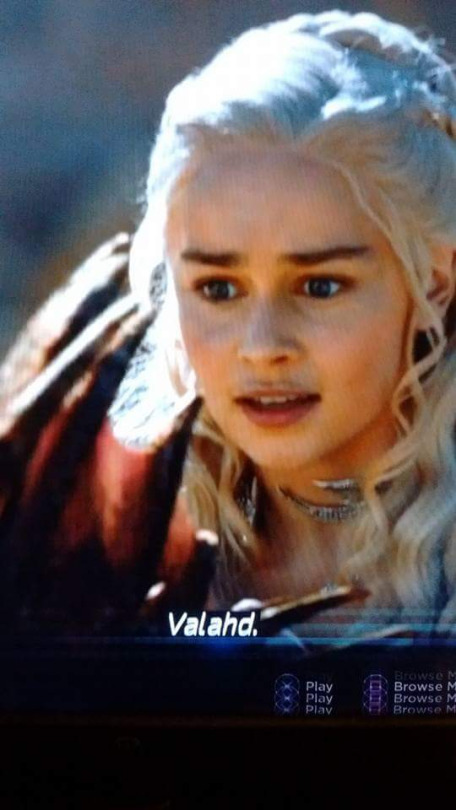
As it was, the scene was outstanding. I was delighted by Emilia Clarke’s performance. She really does speak High Valyrian like a natural. She missed a word or two here or there, but such will happen. Overall, I’m extraordinarily pleased. I’m going to try to go through all the lines, but it’s going to take me a bit (Final Draft doesn’t allow characters with macrons, so there are no long vowels in the script. I’ll have to do a bit of back and forth to get it right). Anyway, Dany gives the following orders to her new army:
- Dovaogēdys! Naejot memēbātās! Kelītīs!
- “Unsullied! Forward march! Halt!”
Of note here is that High Valyrian distinguishes between singular and plural commands. The commands here are plural, as Dovaogēdys is plural, rather than collective.
Then we have a little more Astapori Valyrian from Kraznys, who evidently hasn’t been paying much attention (#distractedbydragon):
- Ivetra j’aspo zya dyni do majis.
- “Tell the bitch her beast won’t come.”
And then Dany’s comeback:
- Zaldrīzes buzdari iksos daor.
- “A dragon is not a slave.”
Of note here: the word for dragon, zaldrīzes. Also, buzdari is stressed on the second syllable even though the a is not long because this isn’t actually a High Valyrian word: It’s an Astapori word that Dany is using on purpose. The High Valyrian word for slave is dohaeriros (whose root you may recognize), but the word they use in Astapor is buzdar, which has its roots in Ghiscari. Dany uses his own word so he’ll know that she knows. (And, by the way, since it’s a borrowing, it goes into the borrowed declension class, which means its accusative ends in -i.) And, indeed, Kraznys now gets it:
- Ydra ji Valyre?
- “You speak Valyrian?”
And then we get, perhaps, my favorite Daenerys line:
- Nyke Daenerys Jelmāzmo hen Targārio Lentrot, hen Valyrio Uēpo ānogār iksan. Valyrio muño ēngos ñuhys issa.
- “I am Daenerys Stormborn of the House Targaryen, of the blood of Old Valyria. Valyrian is my mother tongue.”
(Note: Those who were participating in a previous discussion may want to look at the precise spelling of Daenerys. I guess it has been decided! Forgot about that.)
Then comes quite a long bit of High Valyrian for Dany:
- Dovaogēdys! Āeksia ossēnātās, menti ossēnātās, qilōni pilos lue vale tolvie ossēnātās, yn riñe dōre ōdrikātās. Urnet luo buzdaro tolvio belma pryjātās!
- “Unsullied! Slay the masters, slay the soldiers, slay every man who holds a whip, but harm no child. Strike the chains off every slave you see!”
And then we get Kraznys’ last lines of the show:
- Nyk skan jiva aeske! Zer sena! Zer sena!
- “I am your master! Kill her! Kill her!”
And then Dany says one of the High Valyrian words we already knew, and then comes the sweet, sweet carnage.
What a scene… My hat is off to Dave and Dan. They’ve done great work, and continue to raise the bar.
At the end, Dany says most of the following:
- Jevo glaesoti rȳ buzdari istiat. Kesy tubi jemot dāervi tepan.
- “You have been slaves all your life. Today I give you freedom.”
Next:
- Henujagon jaelza lua vala mirre henujagon kostas, se daorys ziry ōdrikilza. Jemot kivio ñuhe tepan.
- “Any man who wishes to leave may leave, and no one will harm him. I give you my word.”
Finally:
- Yne sytivīlībilāt? Hae dāero valoti?
- “Will you fight for me? As free men?”
I don’t think I missed any long vowels above, but I may have (and if so, I’m sure we’ll get them sorted eventually).
I hope you enjoyed the episode as much as I did. It was an absolute joy to work on High Valyrian, and now that I’ve heard Emilia speak it, I can say that I’m really pleased with the results. I’m also greatly appreciative of the talents of Dan Hildebrand: the latest fallen soldier from Game of Thrones. When I was imagining Kraznys, I was imagining a coarse, revolting, unmannered oaf of a slave master. Dan did the exact opposite of this. His Kraznys is well-cultivated, and speaks with an easy almost callous casualness. It makes his insulting behavior that much more shocking, in my opinion. He seems like a guy who would do well in mixed company, so the fact that he can be so horribly insulting to someone standing right in front of him gives you a totally different picture of what it means to be a slave master in Astapor. He’s so powerful that he simply doesn’t need to care what anyone thinks of him, and it probably never occurs to him that anything he does could be wrong. You did a remarkable job, Dan, and I couldn’t be happier with the way you tackled Astapori Valyrian. Kirimvose!
So now there’s a good batch of High Valyrian (and Astapori Valyrian) material there to work with. When looking at High Valyrian—especially the sentences with relative clauses—bear in mind that, in most important respects, High Valyrian is head-final. Relative clauses are a bit tough—or backwards—for anyone speaking a Western language.
Four down and six to go! Plenty of Valyrian yet to come. Thanks for reading!
Qilōnario Geron
Duh-nuh, duh-nuh, duh-nuh, duh-nuh… THE BEAR AND THE MAIDEN FAIR! Duh-nuh, duh-nuh, duh-nuh, duh-nuh…
All right, I know I work on the show, and it’s outstanding, and I love everybody, and everything is just super 100% awesome, but…seriously, man, ki fin yeni with that outro music? That was one of the most discordant moments of television I’ve experienced in a long, long time. First a scene that must have absolutely shocked viewers unfamiliar with the books, and then cut to spring breeeeeeeeeaaaak! Definitely good for a laugh, though.
There were a lot of magnificent bits in 303. The chair scene was a wonderful bit of absurd theater (and I’ll take anything I can get with Tywin Lannister). If you didn’t see Hot Pie’s wonderful dire wolf confection, here you are:
The funeral in the beginning was genius (that would’ve been me shooting the arrows the first time, by the way. If I were any character in Game of Thrones, that is me all over). And despite what they think over at Winter Is Coming, I loved the scene with Pod, Bronn and Tyrion. Boy’s got game, son! If you can’t step to that, best step off, you feel me?
But I’d like to highlight one scene in particular that I thought was awesome: Stannis and Melisandre. Man! That shoulder’s so cold she got Stannis turning on the AC to warm up! Maybe it was just me, but I was mightily entertained by just how much she was obviously not into Stannis at all. Maybe Jorah has some company coming his way in the Friend Zone, because that was brutal. Reminded me of seventh grade. Very, very well played by Ms. van Houten!
Today we had some more Astapori Valyrian. It was a great scene and very well played—including by the new actor who played the fellow sitting next to Kraznys. (Does anyone know his name—both the character and the actor? He’s just referred to as “Master Slaver” in my sides.) EDIT: The character is Greizhen mo Ullhor, and he’s portrayed by Clifford Barry. (Great job, Mr. Barry!) I could not follow precisely how things got broken up. For example, when Kraznys is going over exactly how many Unsullied he’d give Dany for her Dothraki, etc., it was written up as one long speech. That speech, though, was broken up a bit and delivered in bits here and there, rather than a monologue, so I’m not sure if there’s anything that got cut. Here are a few of the lines from the exchange, though (the ones I remember got in). This is a line from Missandei:
- Ebas pon sindigho uni.
- “She wants to buy them all.”
Now for a word I had fun inventing: the word for dragon (and, no, it’s not related to drakarys. I already roll my eyes enough at the “drak” in that word). Continuing Missandei:
- Ivetras sko o tebozlivas me zaldrize.
- “She says she will give you a dragon.”
And I don’t remember what of Kraznyz’ reply stayed in… I’ll have to watch it again on HBO Go. I do remember he got to say this:
- Ivetra zer ebi ji rovaja.
- “Tell her we want the biggest one.”
Yes, I had fun with this language. Ji rovaja is “the biggest (one)”, and if you know my sense of phonaesthetics, a word like that is like David Bowie wearing something like this:
Pure decadence. I shamelessly wallow in it.
It occurs to me that stress is not nearly as predictable in Astapori Valyrian… I should probably mark the non-predictable stresses, but that’d require some back-tracking. As a general note, though, commands are stressed word-finally (so ivetrá, for example).
Finally, this is Missandei’s last line:
- Pindas sko ji yn tebila, va me rudhy. Pindas sko gomila kizi sir.
- “She asks that you give me to her, as a present. She asks that you do this now.”
Above, for example, tebila and gomila are basically the same construction, but tebila has penultimate stress and gomila has antepenultimate stress. The latter is the odd one.
I’d like to close with a couple of comments. First, check out the transcription project undertaken by Mad Latinist over at his LiveJournal. I haven’t been able to do as much this season because of outside commitments (for example, I’m going to miss the Monday Dothraki chat again, but this should be the last one [well, until LCC5, for which I will probably miss the Dothraki chat yet again]). I feel like there’s going to be enough by the end of the season to put together a fair bit on both Valyrian variants, though—certainly enough to beef up a Wikipedia article, I think.
Second, there is something from the books I’d like to address directly, because I’m utterly baffled by the interpretation. The following excerpt comes from A Feast for Crows (note: this may be slightly spoilerly if you know the context; if you don’t, it should be fairly meaningless):
“What fools we were, who thought ourselves so wise! The error crept in from the translation. Dragons are neither male nor female, Barth saw the truth of that, but now one and now the other, as changeable as flame. The language misled us all for a thousand years. [...] The dragons prove it.”
Many have taken this quote as evidence that High Valyrian is a language without grammatical gender (and for those who are as baffled by that interpretation as I was, I swear, it’s true! Go to the forums and ask around). This quote proves nothing of the kind.
First, what Maester Aemon is talking about here is not grammatical gender but biological gender. In our own world, there are animals that can actually change their gender from male to female, or vice versa (see, for example, the clownfish). Often this happens to aid reproduction. Presumably, dragons in the universe of Ice and Fire are the same—that is, dragons that are, at the moment, male or female, will switch to another gender if it’s required for some reason (this has yet to be revealed).
The part where language comes into this is that the prophecy referred to is originally delivered in High Valyrian, and it refers to a prince. The translation he’s talking about, though, is the translation to Common (i.e. English) which uses the word “prince”, which is male. The assumption, then, was that if that translation caused confusion, it’s because the High Valyrian word can refer to either gender, and, as a result, High Valyrian is genderless.
Not so. First, grammatical gender need not be tied to biological gender (and, indeed, High Valyrian’s genders are not). Second, think for a moment. English is a gender neutral language. We have gendered third person singular pronouns, but outside of that, English has no grammatical genders the way Spanish, French and Italian do. “Prince” is grammatically gender neutral. Semantically, though, it’s male, just as the words “man”, “bachelor”, “father” and “son” are. That these words exist says nothing about the grammatical gender system of English.
So, all this says about High Valyrian is that the word originally used in the prophecy that was translated as “prince” in Common (i.e. English) can refer to either gender (e.g. the way “scientist” can refer to either gender in English). Maester Aemon, here, is commenting on how the assumption, given the context, was that the one prophesied must be male, because this is something that is presumably common in Westeros society (kind of like it still is in ours. Take a random sampling of 100 people and see how many still first think of a man when they hear the word “scientist”)—but, crucially, that it need not be so. That is all this quote is evidence of; it says nothing whatever about the gender system of High Valyrian.
Okay, I should wrap this up. As one more final note, I like to keep it to Game of Thrones here, but if you have some time tonight (or tomorrow night, if you’re outside North America), see if you can tune into the series premiere of Defiance on Syfy at 9/8 Central. I’ve been working really hard for over a year on the series, and the finished product is something everyone involved is really proud of. I’d be delighted if folks would give it a chance, as I think it has a chance to be something really special.
Fonas chek!
Update: Forgot to mention: I’m doing an AMA over at Reddit tomorrow at 6 Eastern.
Tīkuni Zōbrī, Udra Zōbriar
Tonight’s linguistic recap will be short, since there was no Valyrian or Dothraki in episode 302: “Dark Wings, Dark Words.” Of course, I’ve gotten used to this kind of treatment at the hands of Vanessa Taylor… Hee, hee, just kidding. She had some good stuff for me in 204. And the way things work is that stuff always gets moved around after it’s written. I did, in fact, do quite a bit of work for episode 302, but all of it was moved to 301. I wasn’t sure if anything else would get moved to 302, but it looks like it’s been saved for later on.
Some quick comments on 302: Cersei’s line was a crowd favorite (re: Margaery’s dress), and the scene with the Queen of Thorns was wonderful. That scene was a favorite of mine from the books, and I was looking forward to it this season. It did not disappoint. Neither did Brienne fighting with Jaime! That was fun. I could watch that all day. Plus, in that armor, Gwendoline Christie looks like a tank! Truly formidable.
Anyway, since there wasn’t much to discuss language-wise in this episode, I thought I’d go back and fill in a little bit. I’ve been much busier this year than I was last year, and recently, much sicker, so I haven’t been able to do as much as I did in the past. There’s been a lot of discussion about the Astapori Valyrian, though, so I did want to see if I could help out a bit.
Something I thought might help for a start would be just listing the phonology of High Valyrian. This is what it looks like (I’m going to go ahead and use the romanization rather than IPA here):
| Manner | Place | |||||
|---|---|---|---|---|---|---|
| Labial | Coronal | Palatal | Velar | Uvular | Glottal | |
| Stops | p, b | t, d | j, lj | k, g | q | |
| Fricatives | v | s, z (th) | gh (kh) | h | ||
| Approximants | r, rh, l | |||||
| Nasals | m | n | ñ | n* | ||
I’ll try to explain the fuzzy bits as simply as possible. First, if you go to the nasal row, the n with an asterisk next to it simply says that an n will naturally assimilate in place to a following velar or uvular consonant, but that there isn’t a separate velar or uvular nasal. Basically, this means that n works like you would expect it to, and that High Valyrian also has ñ as a separate consonant (and that’s a ñ just like in Spanish, which sounds a little like the “ni” in “onion”).
Next, you’ll see two digraphs in parentheses. These are sounds that aren’t native to High Valyrian, but which have been borrowed in (with greater or lesser success, depending on the speaker). Thus, Dothraki arakh gets borrowed in as arakh, but might get pronounced like arak or arah or maybe even aragh, depending on the speaker. From episode 301, if you hear anything that sounds like either kh or gh, it’s supposed to be gh (Dan’s accent is light on the voiced sounds. I noticed several z’s that sounded like s, a few g’s that sounded like k, and his gh often sounds like kh to my ear).
You’ll also see that three sounds don’t fit in one column and/or row: gh, v and j. These sounds vary in their production. So gh may be strongly velar for some speakers, or strongly uvular for others; the distinction isn’t phonemic. The other two sounds go between approximants and fricatives depending on the speaker and the environment. So v, for example, may sometimes sound like w, and j may sound like a Dothraki j, a Dothraki y or a Dothraki zh, depending on the speaker. In Astapori Valyrian, the j is pretty much always zh. (Oh, and as a side note, the digraph lj is used for the palatal lateral [ʎ]. It’s pretty much always a lateral, but I couldn’t manage the table otherwise.)
At the stage we’re at in the show and the books, though, High Valyrian isn’t spoken as a native language anymore: it’s always a learned second language. As a result, the pronunciation has changed from its purest form. It’s not necessarily important to know how precisely j was pronounced, but that the sound was j (the phoneme) in High Valyrian, if you follow.
Anyway, the vowels are a bit simpler:
| Vowel Height | Backness | |||||
|---|---|---|---|---|---|---|
| Front | Central | Back | ||||
| High | ī, i | ȳ, y | ū, u | |||
| Mid | ē, e | ō, o | ||||
| Low | ā, a | |||||
The first thing to note is that vowels with a macron over them (ī, ȳ, ū, ē, ō and ā) are long. Long vowels are held for twice as long as short vowels, and are quite common crosslinguistically (Arabic has them, Japanese, Hungarian, etc.). Words will be distinguished simply by their vowel length in High Valyrian. The vowel spelled y (and ȳ) is pronounced just like i, but with rounded lips (it’s the u in French tu). This sound may not be pronounced in modern High Valyrian (i.e. High Valyrian spoken by non-native speakers), and didn’t survive in all of the descendent languages. So, for example, the y in Daenerys is probably just pronounced like i (the way we pronounce it), even if in High Valyrian it would’ve been pronounced differently.
In looking at the Astapori Valyrian from 301, note that all long vowels have been lost—and most diphthongs (for example, an Unsullied is a Dovaogēdy in High Valyrian; in Astapori Valyrian, it’s Dovoghedhy). Oh, and since I brought it up, Astapori Valyrian dh is pronounced like the “th” in “this” or “the”. The sound doesn’t exist in High Valyrian.
I’m not sure how much this will help in decoding the Valyrian in 301, but hopefully it will help a little. Since most of it isn’t subtitled, I honestly can’t be sure what made it in and what didn’t (when it’s not subtitled, they feel much more free to cut words or sentences if it’s running long). I already heard from Dan that part of at least one of his sentences was cut, but I don’t know what episode he was talking about. Anyway, to work with something I know came through, here’s the last two lines from 301. First, Missandei:
- Pindas skoverdi Dovoghedhi lis lerraski.
- “She asks how many Unsullied are for sale.”
The word order should be much more familiar in Astapori Valyrian, as it’s lost the cases of High Valyrian, for the most part. It tends to stick to SVO word order. After that is Kraznys’ line:
- Ivetra ji live Vesterozia kisa eva vaneqo.
- “Tell the Westerosi whore she has until tomorrow.”
It was a tough choice, by the way, to go with the name “Westeros” in-universe. I mean, it’s pretty Englishy… I thought of coming up with my own term, but then I relented and decided to just keep it as is: the continent in the west is Westeros, and the continent in the east is Easteros—I mean Essos. Besides, it allowed me to change the w to v, which I thought was fun.
Hopefully this will help you decode what bits remain a bit more easily. Also, though High Valyrian has four genders, Astapori Valyrian just has the two, and in the singular, there are two definite articles: ji and vi.
Anyway, unless things got moved around majorly, there should be a good chunk of Astapori Valyrian next week. Stay tuned!
Geros ilas!
Run Like a Stallion
I’ve just recently come back from ConDor (which was wonderful), and ran into a wall of work. While I negotiate that, though, I’d like to do a couple of things here.
First, Dothraki regular Esploranto has started translating posts on this blog into Spanish! I can’t tell you how excited I am (and, by the way, if anyone else is interested in translating these posts, go for it!), but I’ve run into a technical issue—specifically, how to add these translations to the blog. It’d be odd to post them as new posts (since they’re translations of old posts), and odder still to post them directly after the posts they’re translations of (if I get more translations, there could be, e.g., a single day with like eight posts). What I think would be ideal is if I could add a button to each post that would automatically swap out the original content with the translation. Anyone have any idea how I might accomplish this?
If I can’t come up with a clever solution, what I may do is assign all these posts to some older year (say, a hundred years prior to the original post) and provide a link on each post to the other, plus a note on the translation telling readers when the original post was posted. It’s not an ideal solution, but it’ll allow me to host the content without cluttering up the original run of posts.
Oh, and as a note, I really wouldn’t like to maintain two blogs with the same content, if I can avoid it. I’ve been having enough trouble keeping all my WordPress blogs up to date; I’m loathe to start another.
Second, I got a comment a while back from Aniko asking for the Dothraki translation of the following phrase: Dare to live; it’s easy to die. Let me take some time to translate that.
Step 1 is taking care of the word I didn’t have: dare. Turns out, the English word “dare” goes all the way back to Proto-Indo-European with its meaning mostly in tact (not many words do that). I would’ve been on solid footing to simply coin a new root for Dothraki meaning “dare”, but it didn’t feel right. Right now the word I’d use for “brave” or “courageous” is vezhven. The word has other uses, but it also covers those areas of English’s vocabulary. The idea behind “dare” is to invest one’s courage (whether wise or not) in some enterprise. Many languages have a word related to “brave” they use for “dare”. I wanted to include that tie with Dothraki, but could have done it in a number of ways.
While vezhvenat is a verb, it’s really stative in nature. “To dare” is more of an activity, and I didn’t like any of the options available to me to make vezhvenat more active. In browsing the vocabulary, I came across one item I’d use before to turn vash, “stampede”, into a verb: lanat ki vashi, “to stampede”. I really like this construction, and want to use it more. Thus was born: lanat ki vezhi, “to dare” (and also “to be brave”).
I’m not sure quite how to explain it, but ki is used here to mean “like” or “as” instead of ven, which we’d ordinarily expect. Ven seems more utilitarian, more concrete (it’s certainly a younger preposition), while ki makes the connection seem closer. I think one could actually say lanat ven vezh, to literally say something like Me lan ven vezh, “He ran like a stallion”, but lanat ki vezhi means “to dare”.
Having settled that, this is how I would translate the phrase:
- Lanas ki vezhi thirataan; me disie, jin drivolat.
Obviously do what you will with the punctuation. That said, there are different options here, so let me walk you through them one by one:
- The first verb (lanas) is in the informal imperative. If you’d like it to read more formally, you can change lanas to lani.
- The first clause is “Dare to live”. You can change it up, though, and say Lanas ki vezhi athiraraan, which is saying the same thing in a slightly different way (maybe something like “Dare to go towards life”?). Either construction is acceptable.
- There are a number of ways to say this last bit. One way is to say Athdrivozar disie, which is literally “Death is easy”. (Note: In the original, you can switch out drivolat for athdrivozar if you like the original construction but prefer the verbal noun.)
- Another way to say that same thing is to use the infinitive: Drivolat disie. That would be like saying “To die is easy”.
- And, of course, there are two slightly different words for death at play here. Drivat (and its verbal noun form athdrivar) means “to be dead”. This is a stative verb and describes the state of being dead. Drivolat (and its verbal noun form athdrivozar) means “to die”. So which verb or verbal noun you use depends on what you want to say: Is being dead easy, or is dying easy? Now that I look at it, it’s probably the former, not the latter, in which case you’d want to switch to drivat/athdrivar.
That, though, should give you an idea of what the issues are, and should help you decide what direction you want to go in. Either way, when your tattoo is done, take a picture and send it my way! I’ll put it up here on the blog.
Fonas chek!
February
It’s now February 20th, and this is the first Dothraki post of the month. Given that it’s a short month, this may very well be the last, as well. I feel obliged to offer up some sort of explanation, given that (most months) I’ve been pretty good about living up to my unwritten (until now) four posts per month goal.
As it has turned out, this month has been pretty busy. In addition to the SWTX PCA/ACA Conference from last week, I’m giving a TED University talk at TED this month (a whole 6 minutes on the 28th!), and have been busy doing a lot of prep work for that and for TEDActive, where I’m giving a workshop. If you want to talk any Dothraki, the best place to catch me these days is on Twitter or at our weekly Dothraki chat on IRC.
I didn’t want this post to be completely devoid of Dothraki, though, so I thought I’d address an issue that came up on Twitter. Our latest (and quite prolific!) Dothraki speaker Tyene Sand was trying to translate a sentence using the Night’s Watch (that is, the name “the Night’s Watch”). That can be translated in a number of ways (I offered Vitihiraki Ajjalani), but the translation called for the phrase to be declined in some way. This is where one runs into a dilemma.
In Turkish, if you take a foreign noun and try to decline it, the word behaves a little differently from native (or assimilated) Turkish nouns. Turkish names take a number of case suffixes (similar to Dothraki), but these suffixes participate in vowel harmony. Here’s a small example:
| Turkish (Nominative) |
English | Turkish (Locative) |
English |
|---|---|---|---|
| mağaza | store | mağazada | at the store |
| göl | lake | gölde | at the lake |
As you can see, in the Turkish forms in the third column, there’s a suffix that’s either -da or -de. Which suffix you get depends on the character of the previous vowel (for more, see this article on Turkish vowel harmony), but they both mean the same thing.
That’s fine and good. What happens, though, when you add these suffixes to a foreign word? Turkish, as it turns out, does a couple of things differently. First, the suffix is always attached with an apostrophe (kind of like how sometimes in English, acronyms are pluralized with an ‘s as opposed to just s [e.g. DVD's rather than DVDs]). Second, unless the quality of the vowels is quite apparent, Turkish just uses one of those two suffixes—specifically, the -da suffix. Here’s an example:
| Turkish (Nominative) |
English | Turkish (Locative) |
English |
|---|---|---|---|
| Google’da | on/at Google |
So, now that we know what Turkish does, what does Dothraki do?
First, Dothraki noun phrases are often declined on the head noun. This is the rough equivalent of “passerby” vs. “passersby” in English (the latter being the formal plural of the former). Take, for example, the phrase asavva evomen, which has various meanings depending on context (for now, let’s say “afterlife”). If one wanted to pluralize this phrase, the appropriate plural would be asavvasi evomeni (the latter adjective taking an -i on account of concord). That is, asavva is the head noun, so it takes the plural; one doesn’t treat the whole thing as a single noun and attempt to add some sort of inflection to the end of evomen.
That said, one may want to write in Dothraki and talk about modern people, companies, products, places, etc. For something like “Google”, one option would be to try to translate the concept (good luck) or to render it in Dothraki (Gogol?). This might end up making things more confusing than necessary, though. As a result, the kind of catch-all repair strategy used in Dothraki is the preposition haji. Haji means something like “because of” or “on account of” or sometimes “with respect to”. In Dothraki proper, its meanings are a bit more specific. When used in conjunction with foreign names or terms, though, it stands in for any preposition and/or the genitive, allative or ablative cases. Thus, one might say something like:
- Anha tih mae haji Reddit.
- “I saw it on Reddit.”
Technically haji there could be standing in for she, ma, irge, hatif, vi, ha, ki—or the ablative, genitive or allative cases. Really, though, given the context, it seems likely that it’s standing for she (a general locative. Not sure if anything more specific would be used to refer to something one sees on a webpage. Mra, maybe?). One might be able to supply a context that would force another reading, but the most obvious reading suggests that whatever was seen was seen on Reddit.
Though the solution is pretty simple, the drawbacks are that there could be confusion or ambiguity, so it behooves one to supply the proper context so that only the correct interpretation is plausible. If more specificity is absolutely required, one can always use the proper preposition. If a case is needed, it’s probably best to attempt to render the noun in Dothraki, as below:
- Anha dothrak Disneylandaan!
- “I’m going to Disneyland!”
To make it clear, one may (in the Turkish style) separate the case ending from the root with an apostrophe, but personally I prefer it without.
I hope your February’s going well and that it’s not too cold where you are! It rained today, so California will get a bit chillier for the next couple of days, but otherwise I can’t complain. For those of you who speak or are familiar with other case languages, what do those languages do with foreign proper terms? How would “Google” come out in the instrumental in Russian? Or the translative in Finnish?
Dothras chek!