Monthly Archives: June 2012
Jalan Atthirari Anni
If I may step away for a moment from my regularly-scheduled Dothraki posts, today my wife and I celebrate our four year wedding anniversary (though in November we will have been together ten years). Erin has stood beside me and supported me ever since we’ve been together—and that can’t have been easy. She supported me when I decided to leave graduate school to teach community college. She supported me again when I decided to leave teaching to write, with little to no prospects. She supported me yet again when I left off writing to apply for the Dothraki job, and continued to support me as I had to tell friends and family vague details about my doing “something” that was “work”, though I couldn’t tell them anything about it. It’s not a prototypical path to success (looking back, in fact, it sounds rather like the exact opposite)—and who knows how it’ll pan out five to ten years down the line—but Erin’s steadfast support and encouragement have been instrumental in my being able to muddle my way through a taxing (to say the least) decade—not to mention her linguistic expertise. (It’s great to have someone I can talk to about conlang problems!)
I’ve tried my best to thank Erin along the way however I could (I’ve already mentioned how the word erin, “good, kind”, was coined in her honor, as was alegra, “duck” [her middle name]), but I don’t think I’ve done so publicly, so I figure this is as good an opportunity to do so as any.
Erin: Thank you so much for four wonderful years of marriage, and close to ten wonderful years together. Yer jalan atthirari anni. Every day I get to spend with you is a day worth living. Anha zhilak yera nakhaan, ma hash anha laz et mae, hash anha akemok ma yeroon save. Happy anniversary!
Anha Tihak Yera
Little multiconlingual pun there for you. A while back, I was profiled on the CNN show The Next List. When I was prepping for the show, they asked me if I could get some videos of fans speaking Dothraki—about a minute, they said. I don’t think they understood just how long a full minute is, because the videos (supplied by our own Hrakkar and Daenerys) only show up on screen for a few seconds, and they had to do a lot of work to produce (and pronounce!) a full minute of Dothraki dialogue. It was a lot of work (and hopefully fun!), and since you only get to see a very little bit on the show, I thought I’d put both videos up here.
The first is Hrakkar’s video, which is actually a reading of the LCC4 conlang relay text I did for the Fourth Language Creation Conference. The text is called Dorvi Zichome, or “The Disrespectful Goat”, and here it is:
Right on! Dig the lion décor. (By the way, sorry the still image it starts with is a bit pixellated. No idea thy it’s doing that—or why I can’t embed my own darn videos and have to go through Photobucket. Hope you have flash, if you’re reading this… When is HTML5 getting here?!)
(Update: I believe I fixed the image problem. The funny thing [for me] is that I fixed this problem before this post was ever posted, so no one but me ever actually saw the problem. Ha, ha… Anha nemo allayafak…)
Our next video is from Daenerys, who wrote her own script, which must have taken quite a while!
Thanks so much to Dany and Hrakkar! Anha chomak yeri ma anha vemerak ma athhajaraan ma oakahaan yeri!
In other news, I’m going to speaking at the American Mensa Annual Gathering next week. I believe you have to be a Mensa member to attend, but if you are (and you’re going to be in Reno), stop on by!
Recently, I participated in the Conlangery podcast where we discussed Dothraki and growing a lexicon. You can listen to the podcast here. I also did an interview with Saul Gonzalez over at KCRW today. Not sure when it’ll be going up, but when I get word, I’ll let everyone know. Finally, last weekend I gave a conlang workshop at WyrdCon 2012. The convention was a lot of fun, and I got an INCREDIBLE medallion—just for attending! Everyone who attended got one of these (it was the equivalent of a name badge at other conventions). Check it out:
That’s metal—die cut. I honestly wish I was the type of person that wore necklaces and that I had a reason (and the wherewithal) to wear this around. I’m going to do something with it; just not sure what yet.
Oh, but yeah. The whole reason this came up is because I did an interview (or a couple of them) while I was at WyrdCon, and you can read a post about one of them here. (By the way, shout out to Brittany Hanson, who works for the Garden Grove Journal—my local hometown paper! If you go there right now you can read about my old high school’s baseball team winning the CIF championship this year. Go Mariners!)
Also, I recently started a Tumblr account. Not sure where it’ll go, but if you’d like to follow me there, you can do so here.
The Dothraki lexicon and reference grammar document just ticked over to 300 pages yesterday! The language continues to grow, albeit slowly as I’ve gotten bogged down with other work. Until next time, hajas!
Hash Yer Ast Fin…?
The finale has come and gone, so I thought it might be fun to take a look back at my last Dothraki adventure from season 2. In addition to elucidating a key piece of dialogue from episode 210, it’ll also give you a glimpse into what it’s like to work as a conlang translator for a show like Game of Thrones.
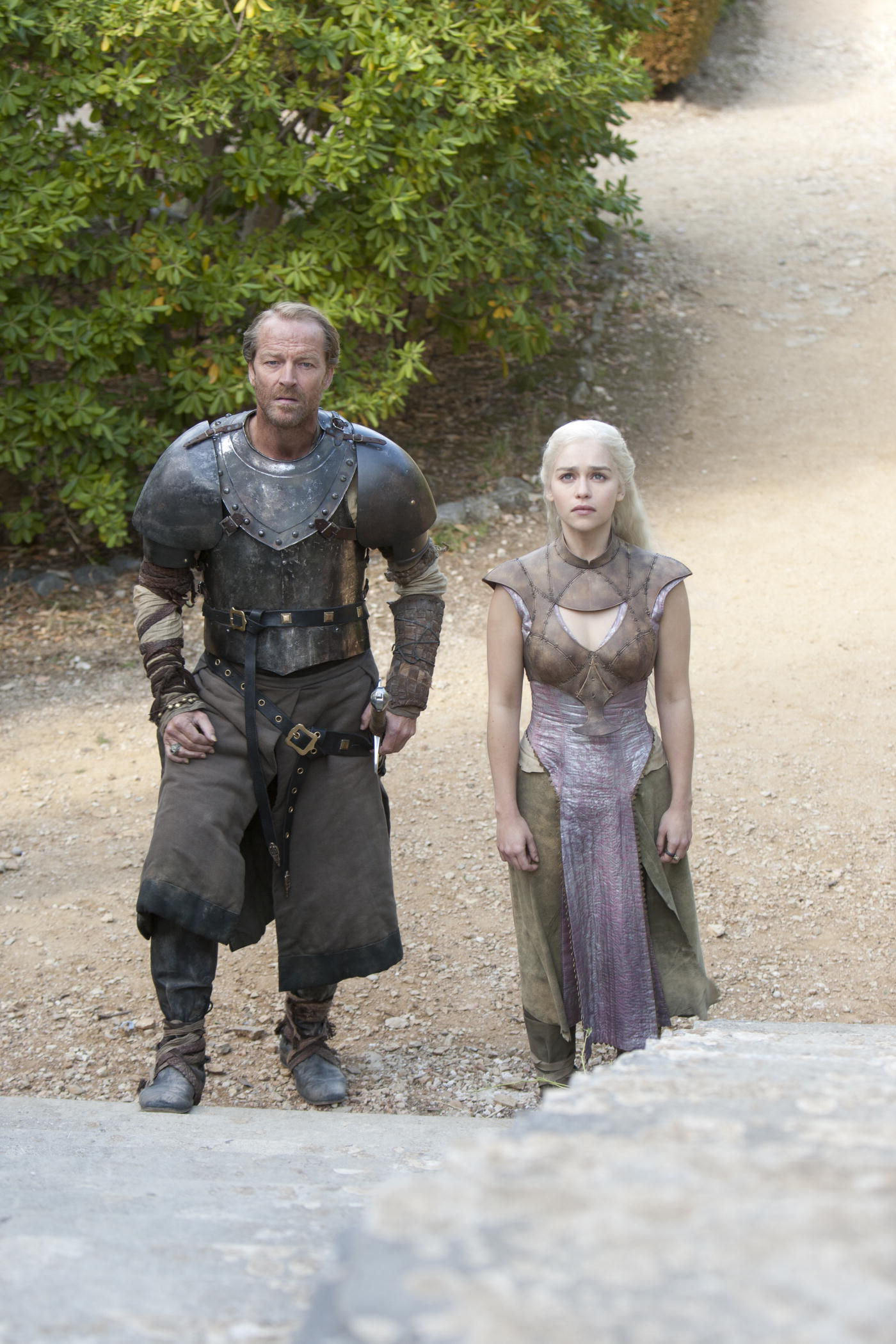
As was mentioned in the last post, the final Dothraki line of season 2 is Jorah’s, and it’s shown below (with its on screen translation):
- Mas ovray movekkhi moskay.
- “Take all the gold and jewels.”
As those who’ve studied a bit of Dothraki probably realized, there’s not much tie between those words and that translation. In fact, one might say that none of those Dothraki words corresponds with any of the English words of the translation—and such a one would be correct. This is what happened.
At around 1:45 a.m. Pacific Time on October 10th, 2011 I was feeling sleepy, and was thinking about going to bed. This was unusual for me, because generally when I’m doing work for Game of Thrones, I go to sleep between 4:00 and 5:00 a.m., as it’s not uncommon for me to get a translation request around 4:00. It’d been a few weeks since I’d done anything at all for the show, though, and I was, for all intents and purposes, done, so on this night in particular I thought to myself, “You know what? I’m going to switch to a more normal schedule: In bed at 2:00 a.m., up at 10:00 a.m.” Pleased with my decision, I shut my computer and everything down and went to sleep at 2:00 a.m.
As luck (or fate) would have it, I received an e-mail from Bryan Cogman at 4:03 a.m. entitled “EMERGENCY Dothraki line!!!” He said they needed the Dothraki for “Take all the gold and jewels”, and they needed it in a couple hours. I ended up reading this e-mail at around 1:00 p.m. on the 10th, because I way overslept (you have reasonable control over the time you go to sleep; not necessarily over the time you wake up). Even though it was late, I quickly translated the line and sent it off to Bryan at 1:09 p.m. The line translated into Dothraki was:
- Fichas ei hoshor ma dan.
- “Take all the gold and jewels.”
Unfortunately, it did not, in fact, make it in time. Bryan wasn’t on set that day, but he said he thought they did it in Common—which is unfortunate (the more Dothraki, the better!), but what could I do? So I chalked that one up to bad luck, and promptly forgot about it.
Until May 29th, 2012.
At 2:17 p.m. I got an e-mail from the Game of Thrones postproduction supervisor asking for the Dothraki version of “Take all the gold and jewels”. While I think it’s primarily for foreign language versions of the show, they use the actual Dothraki lines for something in post (you never see them in the standard English broadcast without subtitles), and every so often something gets in that they can’t find the Dothraki translation for, so they ask me. In this case, I was a bit baffled, as I could’ve sworn my Dothraki translation for that line didn’t make it in. I sent her the correct translation above and asked if it sounded right, and she said that it sounded a “little different”. She then e-mailed me a recording of the line:
…and I’m all like, Ki fin yeni?! Then I realized what happened: They wanted Dothraki, so they had Iain Glen ad-lib. Now, we’ve seen some ad-libbing before, but never a sentence this long—and never for a sentence for which an actual Dothraki translation was already available (translating the above required no new Dothraki words). So I asked if I could have a day (bearing in mind that this episode would be airing in five days), and set to work.
My narrow transcription of what Iain Glen says is something like this (treating it like one big word with several main stresses):
[ma.so.ˈbɾaj.mo.ˈvɛ.hi.mɔs.ˈkaj]
There’s no [b] in Dothraki, of course, but all that means is it makes no difference if you pronounce something with [v], [b] or even [β]—and there’s probably a fair amount of dialectal/idiolectal variation. So the fact that there is (to my ear) a clear [b] in his ad-lib is no big deal. No, the thing that tripped me up was the presence of two [aj] diphthongs. As both are stressed, my immediate reaction was: participle. Participles in Dothraki aren’t common, but they’re possible—and most end in -ay (or [aj]). With that in mind, then, I could break down the stream into at least the following:
[ma.so.ˈbɾaj mo.ˈve.hi.mos.ˈkaj]
At this point, it was a matter of chopping up words even further. Both the participle syllables could not stand on their own (if they did, they would need to come from the words brat/bralat or kat/kalat, respectively, both of which would end up violating Dothraki minimal word constraints in one tense or another), which means that they’d need to borrow at least one mora from a previous syllable. Seeing as participles most comfortably modify nouns—and seeing as the word ma is already a word in Dothraki and isn’t a noun—I decided the first chunk absolutely had to be mas ovray. As for the second, there’s that other stress to contend with. Having non-initial stress on an open syllable is nearly impossible in Dothraki, and seeing as -i is a ready verb ending, I decided to make the last participle moskay, leaving the middle part [mo.ˈve.hi].
Something that helped me out tremendously was Iain Glen’s character being non-Dothraki. One thing that non-native speakers will do is mispronounce tough consonants. So if you have a verb that’s [mo.ˈve.hi], there almost certainly must be a geminate. And since a geminate velar fricative would likely be flubbed by a non-native speaker, I decided that this verb would somehow relate to vekhat: a verb so semantically empty I could make it mean just about anything.
Once I had the words chopped, I had an even greater challenge: To create something grammatical that would have the same intended meaning as “Take all the gold and jewels”. The presence of participles made this more difficult than it might have otherwise been, but I saw this as an opportunity to fill in some gaps in Dothraki’s vocabulary.
For the first chunk, I decided that mas should refer to valuables, and ovray should mean something like “remaining”. Since I already had a word for “remain”, though, I poked around to see what I didn’t have. While I had something meaning “slack” (as in a rope), I didn’t have a word for something that was not attached, or not fastened down. As a result, ovray came to mean “loose” or “moveable”—and (especially) “portable”. I was able to use the same stem to derive the word ovrakh, which means (depending on context) “opening”, “availability”, “opportunity”, “vulnerability”, “weakness” or “weak point”. From mas I created a word meaning “to decorate” (ammasat).
The word movekkhat is a strange one, I’ll admit. It derives from the phrase nemo vekkhat. The latter verb is no longer really used by itself and the product of an old derivational strategy that you see in verbs here and there (e.g. lorat “to wink” ~ lorrat “to blink”), and it’s used to mean “to be intended for” or “to be for”. Vekhat means “to exist”, so vekkhat kind of extends that meaning. Since it was conventionally used with a reflexive subject, the mo of nemo glommed on to the front of the verb, until it eventually became a new verb (not an unusual process).
As for the last word, moskay, it means “to load” (a moska is a pack or sack used for transporting goods). Here is where I, yet again, took advantage of Jorah’s non-native intuition. To say something like “Everything not nailed to the floor is intended for transporting”, you’d actually use the infinitive. So, properly, the translation ought to be:
- Mas ovray movekkhi moskat.
- “The loose valuables are for loading.”
You could also use athmoskar, I guess, but moskat makes more sense to me. Jorah, though, comes from a language (Common, a.k.a. English) that makes much greater use of its participles—and also has a form that doubles as a gerund (e.g. “running” is a participle and a gerund). So it’s understandable if instead of using the correct infinitive he uses the participle.
And that’s how the last line of the season went from 100% ad-lib to official Dothraki. I sent off the above translation the next day, and it became canon. If he ever happens across this post, let me give a big thank you to Iain Glen for coming up with some phonologically plausible Dothraki! That’s not as easy to do as one might think.
Yet again I’ve written too much, so I’ll close this up. Thanks for reading! There’ll be more Dothraki tidbits throughout the offseason.